
Organic Meat
in the UK
What the labels actually mean, why the ethics matter more than the marketing, and how to find producers worth buying from.
If there's one area of our diet we've never compromised on, it's meat. Not because we eat a great deal of it — we don't — but because we think it matters more here than anywhere else.
We've been buying organic meat since 2021, and we'll be honest — it started as much about what we were avoiding as what we were gaining. Routine antibiotic use. Factory farming. Animals that never see a field. The more we looked into conventional meat production, the less comfortable we were with it.
The taste difference is real. The cuts are better. But the reason we've never gone back is simpler than that — we just feel better about it. This guide is our attempt to cut through the label confusion and help you buy with confidence.
Organic meat
by type
What "organic" actually
means for meat
In the UK, organic is a legally protected term. A producer cannot simply call their meat organic — they must be certified by an approved body and pass annual independent inspections. The main certifiers are the Soil Association and OF&G (Organic Farmers & Growers). Both are rigorous. Both mean something.
At a minimum, certified organic meat means the animal was raised in free-range conditions with genuine access to pasture, fed a diet free from synthetic pesticides and GMOs, and not given routine antibiotics. That last point matters enormously. In conventional farming, antibiotics are often administered to entire herds as a precaution — a practice directly linked to the global rise of antibiotic-resistant bacteria.
Organic certification also prohibits growth-promoting hormones. These are already banned under UK law, but the certification gives you an additional layer of independent verification that the ban is being followed.
The Soil Association goes further than the legal baseline in several areas — stricter stocking densities, stronger pasture access requirements, and tighter controls on what animals can be fed. No system of farming in Britain has higher verified animal welfare standards.
This isn't marketing copy. It's the result of decades of standards development, independent oversight and regular farm inspections. When you see the Soil Association logo, something meaningful has been checked.
The scientific evidence on whether organic meat is measurably healthier for you is genuinely mixed. Some studies show higher omega-3 levels in grass-fed beef. Others show minimal difference. We're not here to overclaim.
What we are confident about is what organic meat doesn't contain — routine antibiotic residues, synthetic growth promoters, and the welfare compromises of intensive farming. For us, that's more than enough.
Grass fed, pasture raised —
what do they actually mean?
This is where we get genuinely frustrated, and where we think shoppers are most frequently misled.
"Grass fed" is not a regulated term in the UK. There is no legal definition, no required percentage of diet, and no independent verification process attached to it. A producer can put "grass fed" on the packaging of an animal that spent significant time indoors eating supplementary feed, and there is currently nothing to stop them.
The same goes for "pasture raised." It sounds meaningful. It often isn't. Without certification, it's marketing.
We've stood in supermarket aisles reading packaging that says "grass fed" with no further detail — no percentage, no certification, no indication of how long the animal actually spent on pasture. It's frustrating, and it's something the industry has been slow to address.
The one certification that genuinely means something here is Pasture for Life. This guarantees the animal was fed exclusively on pasture for its entire life — no grain finishing, no supplementary feed, 100% grass. It's a high bar that relatively few producers meet, which is precisely why it's worth seeking out.
Pasture for Life and organic certification are different things. An animal can be Pasture for Life certified without being organic, and vice versa. The best producers hold both. If you can only have one, we'd prioritise organic for the antibiotic and welfare guarantees — but Pasture for Life is the more meaningful standard for grass-fed claims specifically.
Our advice: ignore "grass fed" on a label unless it's backed by Pasture for Life certification, or the producer can tell you the exact percentage of the animal's diet that was grass, and for how long.
The ethics case —
honestly made
We're not going to tell you that buying organic meat makes you a good person, or that conventional farmers are bad ones. That's not how this works. Most farmers — conventional or organic — care deeply about their animals and their land.
What certification does is create a verified floor. It means that regardless of how you feel about any individual farmer or brand, you know certain things have been independently checked. The animals had access to pasture. They weren't kept in close confinement. Routine antibiotics weren't used. Someone physically visited the farm and signed off on it.
That floor matters. Because without it, welfare claims are just words on a packet.
Factory farming — intensive indoor systems where animals are kept at high density, often unable to express natural behaviours — remains the dominant production method for much of the chicken, pork and beef sold in UK supermarkets. Organic certification rules this out entirely.
For us, meat is the one food category where the ethical argument is clearest and the premium most justified. You are paying for an animal that lived differently. That lived better. And in most cases, the meat tastes better for it — slower-grown animals with more varied diets simply produce more flavourful cuts.
We'd rather eat less of it and eat it well.
Reading the labels —
a plain English guide
Not all logos are equal. Here's what each one actually means when you see it on a pack of meat.
What good organic
farming looks like
The best organic meat producers in Britain operate on a model that looks nothing like a conventional farm. Animals are raised slowly — beef cattle might take two to three years to reach slaughter weight compared to 18 months in intensive systems. That slower growth is part of what makes the meat better.
Rotational grazing — moving animals between pasture fields on a regular cycle — is central to good organic farming. It prevents overgrazing, builds soil health, sequesters carbon and supports the wildflower and insect populations that have collapsed on intensively farmed land.
Mob grazing takes this further — moving large herds across smaller areas more frequently, mimicking the natural behaviour of wild herds. When done well, it can dramatically improve soil carbon levels and restore degraded pasture within a few seasons.
Silvopasture — integrating trees into pasture systems — is increasingly practised by forward-thinking organic farms. Trees provide shade and shelter for animals, improve soil structure, support biodiversity and sequester additional carbon above and below ground.
Organic standards require that a significant proportion of an animal's feed comes from the farm itself — reducing dependence on imported soy and the deforestation linked to it. This is a genuinely meaningful environmental distinction that rarely gets the attention it deserves.
Well-managed permanent pasture is one of the few agricultural systems that can be genuinely net positive for biodiversity. A single organic farm can support hundreds of species of plants, insects and birds that would struggle to survive on intensively farmed land.
The farms we feature in this directory have been selected because they go beyond certification minimums — producers who are genuinely proud of their methods and transparent about them. If a producer won't tell you how their animals are raised, that tells you something too.
The nitrate problem —
what you need to know
If there's one area of the meat industry where we think the evidence is clearest and the public most poorly informed, it's cured and processed meat. Bacon, ham, salami, chorizo, sausages — the products most people reach for without a second thought.
In 2015, the International Agency for Research on Cancer — the WHO's cancer research body — classified processed meat as a Group 1 carcinogen. That puts it in the same category as tobacco and alcohol. Not because eating a rasher of bacon is as dangerous as smoking, but because the evidence that it causes cancer in humans is considered definitive.
The primary concern is nitrites — the chemical preservatives added to most cured meats to prevent bacterial growth and give them their characteristic pink colour. When ingested, nitrites can form N-nitroso compounds in the body, some of which are known to damage the cells lining the bowel.
Research from Queen's University Belfast, published in the journal Nutrients, reviewed 61 existing studies on processed meat and bowel cancer risk. When they separated out nitrite-containing processed meats specifically, 65% of studies showed evidence of a link with colorectal cancer — compared to around half when all processed meats were grouped together.
The IARC reported that consuming just 50 grams of processed meat daily — roughly two rashers of bacon — increases the risk of bowel cancer by around 18%. Bowel cancer is the fourth most common cancer in the UK, with around 42,000 new cases diagnosed each year.
In October 2025, four scientists involved in the original WHO declaration wrote to the UK Health Secretary urging mandatory warning labels on nitrite-cured products. They estimated that inaction since the 2015 WHO classification has contributed to 54,000 cases of bowel cancer in Britain.
It's worth being clear about what the science does and doesn't say. The evidence links nitrite-containing processed meat to increased bowel cancer risk. It does not prove that nitrite-free versions are definitively safer — the research on this is still developing. But it does suggest the nitrites themselves are a significant part of the problem.
Truly organic charcuterie — made without added nitrites or nitrates — is genuinely difficult to find in the UK. Most producers who claim to be nitrate-free use celery powder or other vegetable-derived nitrate sources, which convert to nitrites during curing. Regulators and researchers are divided on whether this is meaningfully different.
We eat bacon and charcuterie occasionally and we're not going to pretend otherwise. But we buy nitrate-free where we can find it, we don't eat it daily, and we think everyone deserves to know what the evidence actually says. The producers we feature in this directory are transparent about their curing methods.
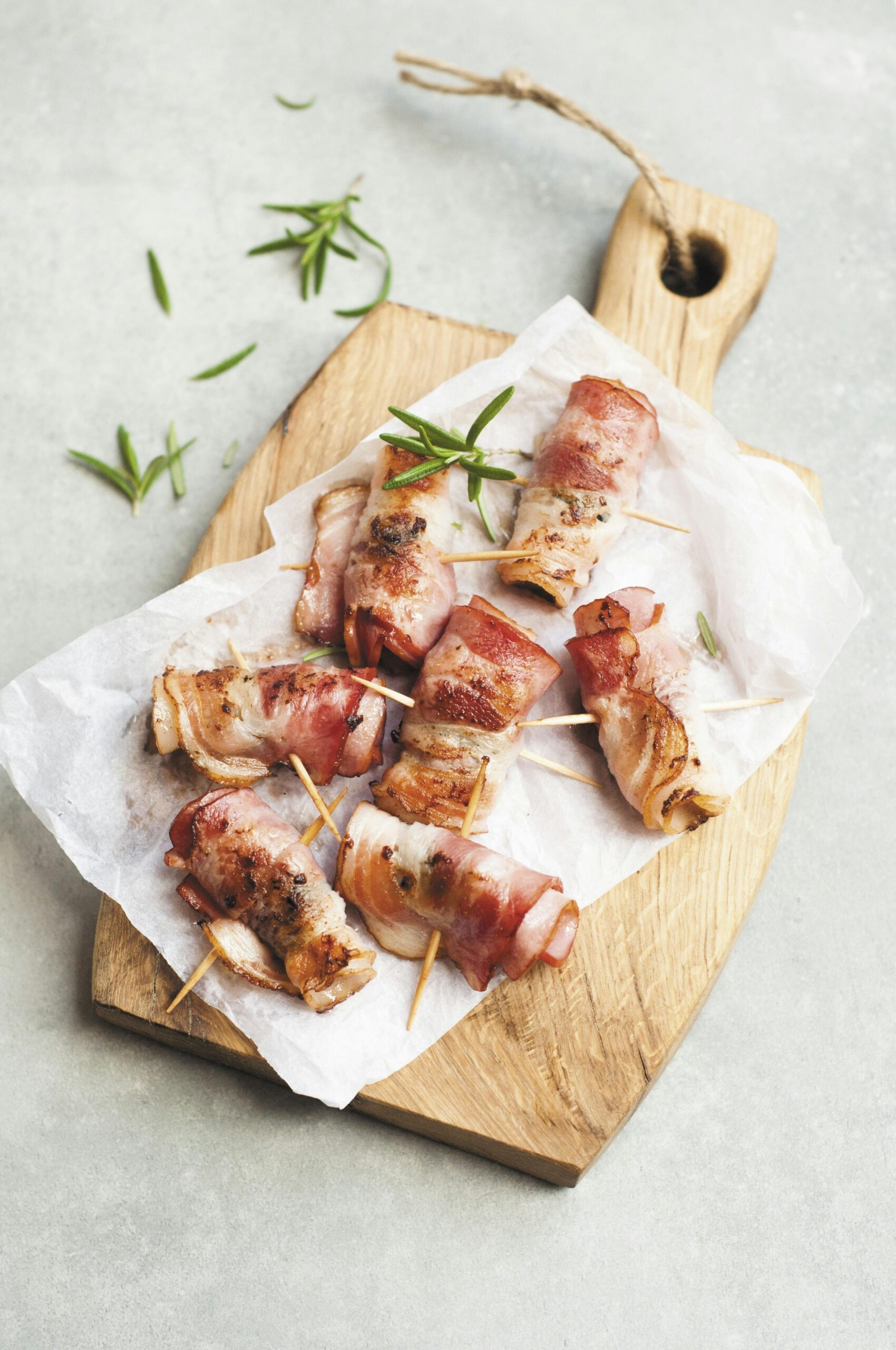
What 50g of processed meat
actually looks like
The daily amount at which an 18% increased risk of bowel cancer was observed. Less than most people assume.
Source: IARC / WHO 2015. Bowel cancer figures: Cancer Research UK. 54,000 figure: letter to UK Health Secretary from IARC scientists, October 2025.
Find organic meat
producers near you
Browse our directory of certified organic meat producers, butchers and delivery services across the UK — all independently verified.