Organic Pork
in the UK
An honest guide to one of Britain's most intensively farmed animals — the welfare reality, what organic actually changes, and the rare producers doing it properly.
Pork is the meat we think hardest about. Not because we've stopped eating it, but because the more we looked into how it's produced, the less comfortable we became with buying it without knowing exactly where it came from.
Pigs are among the most intelligent animals farmed for food. They are curious, social and capable of complex problem-solving. They form strong bonds, communicate with each other, and suffer measurably under stress. The conditions in which the vast majority of British pigs are raised — indoors, in high-density systems, often unable to express natural behaviours — are difficult to square with that intelligence.
We don't eat a great deal of pork. When we do, we're particular about where it comes from. Organic certification makes a genuine difference here — not just in the absence of routine antibiotics and synthetic feed additives, but in the fundamental conditions of the animal's life. Outdoor access. Rooting behaviour. Natural social structures. These things matter.
This guide is an honest account of what conventional pig farming looks like, what organic certification actually changes, why sausages and cured pork present their own specific problems — and the small number of producers we think are genuinely worth buying from.
What conventional pig farming
actually looks like
The majority of pigs raised for meat in Britain spend their entire lives indoors. Not in barns with straw and space to root — in concrete-floored systems with slatted floors, at stocking densities that prevent most natural behaviour. Pigs are highly motivated to root — to use their snouts to investigate and manipulate their environment. In concrete systems, they cannot. The frustration this causes is measurable and well documented.
Tail docking is routine in conventional pig farming in Britain. It is technically illegal without veterinary justification, but widely practised — because pigs in overcrowded, understimulating environments bite each other's tails, and tail biting is easier to prevent by removing the tail than by improving the conditions that cause it. The practice is a symptom, not a solution.
Farrowing crates — metal cages that confine sows around the time of birth — are used across the majority of British pig farms. The crate prevents the sow from turning around for several weeks. The justification is that it reduces the risk of the sow lying on her piglets. The welfare cost is significant — sows show clear signs of distress when confined and are unable to express the nesting behaviour that is a strong biological drive before farrowing.
The UK government has repeatedly committed to banning farrowing crates and has repeatedly delayed doing so. As of 2026, they remain legal and widely used. The pig farming industry has resisted reform on the grounds of cost and competitiveness — arguing that banning crates without equivalent restrictions on imports would simply move production overseas.
Routine antibiotic use in pig farming has been reduced significantly in recent years following pressure from government and retailers. But it remains higher than in most other livestock sectors, and the conditions that drive disease — density, stress, poor air quality — remain largely unchanged in conventional systems.
We're not going to tell you that buying organic pork makes all of this go away. It doesn't. But organic certification — particularly Soil Association certification — rules out the worst of it. Farrowing crates are prohibited. Routine tail docking is prohibited. Outdoor access is required. The gap between the best organic pig farming and conventional intensive production is as wide as anywhere in British agriculture.
What organic certification
actually guarantees for pork
Certified organic pig farming in the UK operates under standards that are fundamentally different from the conventional baseline. The Soil Association's organic standards for pigs are among the most rigorous in the world — and they address the specific welfare failures of conventional production directly.
Farrowing crates are prohibited under Soil Association standards. Sows must be able to move freely around the time of birth and must have access to nesting material. This is not a minor distinction — it represents a completely different approach to farrowing that prioritises the sow's behavioural needs over production efficiency.
Organic pigs must have continuous access to outdoor range or, where outdoor access is genuinely impossible due to weather or ground conditions, deep straw bedding that allows rooting behaviour. The outdoor requirement is meaningful — pigs on organic farms are observed rooting, exploring and exhibiting a range of natural behaviours that are simply impossible in concrete indoor systems.
Routine tail docking is prohibited. Because organic pigs are kept at lower densities, with more environmental enrichment and genuine outdoor access, the tail biting behaviour that drives routine docking in conventional systems is significantly less prevalent.
Feed must be organically produced and free from genetically modified ingredients. The proportion of the diet that can come from non-organic sources is tightly limited and reducing. Routine antibiotic use is prohibited — antibiotics can be given when an animal is genuinely ill, but not administered preventatively to entire groups.
Stocking densities are lower than conventional systems both indoors and outdoors. The maximum number of pigs per hectare of outdoor range is set and enforced. These limits exist because overcrowding is the root cause of most welfare problems in pig farming — reduce the density and most of the other problems reduce with it.
The gap between Soil Association organic and standard outdoor bred or outdoor reared pork — labels you will commonly see in supermarkets — is significant. Outdoor bred means the sow farrowed outdoors but the piglets were moved indoors after weaning. Outdoor reared means the pigs spent part of their lives outdoors. Neither carries the same guarantees as organic certification, and neither prohibits farrowing crates for breeding sows kept indoors.
Outdoor bred: sow farrowed outside, piglets finished indoors. Better than nothing.
Outdoor reared: pigs spent some time outdoors. Vague and unverified without certification.
Free range: not a legally defined term for pork in the UK. Means very little without certification.
Soil Association organic: the gold standard. Farrowing crates prohibited, outdoor access required, routine antibiotics prohibited, independent annual inspection.
The sausage problem —
why cured pork deserves more scrutiny
Sausages are where pork gets complicated — and where we're most cautious. A sausage is a processed meat product, and processed meat carries all the nitrite concerns we cover in detail on our organic meat page. Most sausages — including many marketed as organic or high welfare — contain sodium nitrite as a preservative. The link between nitrite-cured processed meat and bowel cancer risk is well established.
Finding genuinely organic, genuinely nitrate-free sausages in the UK is difficult. Most producers who claim to be nitrate-free use celery powder or other vegetable-derived sources of nitrate, which convert to nitrites during the curing process. The end product contains nitrites — just derived from a natural source rather than a synthetic one. Whether this is meaningfully different from a health perspective is contested. We would not describe a celery-powder sausage as nitrate-free.
Truly nitrate-free sausages — made with only meat, fat, seasoning and a natural casing — do exist but are rare. They have a shorter shelf life, a greyer appearance and a different texture to nitrite-cured equivalents. If you find a producer making them properly, they are worth supporting.
Bacon presents the same problem. The pink colour of bacon is produced by nitrites — without them, bacon is grey. Most consumers find grey bacon unappealing, which is precisely why the industry uses nitrites so universally. Nitrate-free bacon exists but is genuinely hard to source and rarely available in supermarkets.
Our honest position on sausages and bacon is this: we eat them occasionally, we buy organic where possible, and we don't eat them daily. The IARC figure — an 18% increased bowel cancer risk from 50 grams of processed meat daily — is worth keeping in mind. Two rashers of bacon is 50 grams. We cover this in detail on our charcuterie page.
We buy organic sausages when we can find them, accepting that most will contain some form of nitrite. We eat them occasionally rather than regularly. For bacon we do the same. It's not a perfect position — but it's an honest one. The producers listed on this page are transparent about their curing methods and worth asking directly if you want to know exactly what's in their products.
Jamón Ibérico —
the one pork product we don't hesitate over
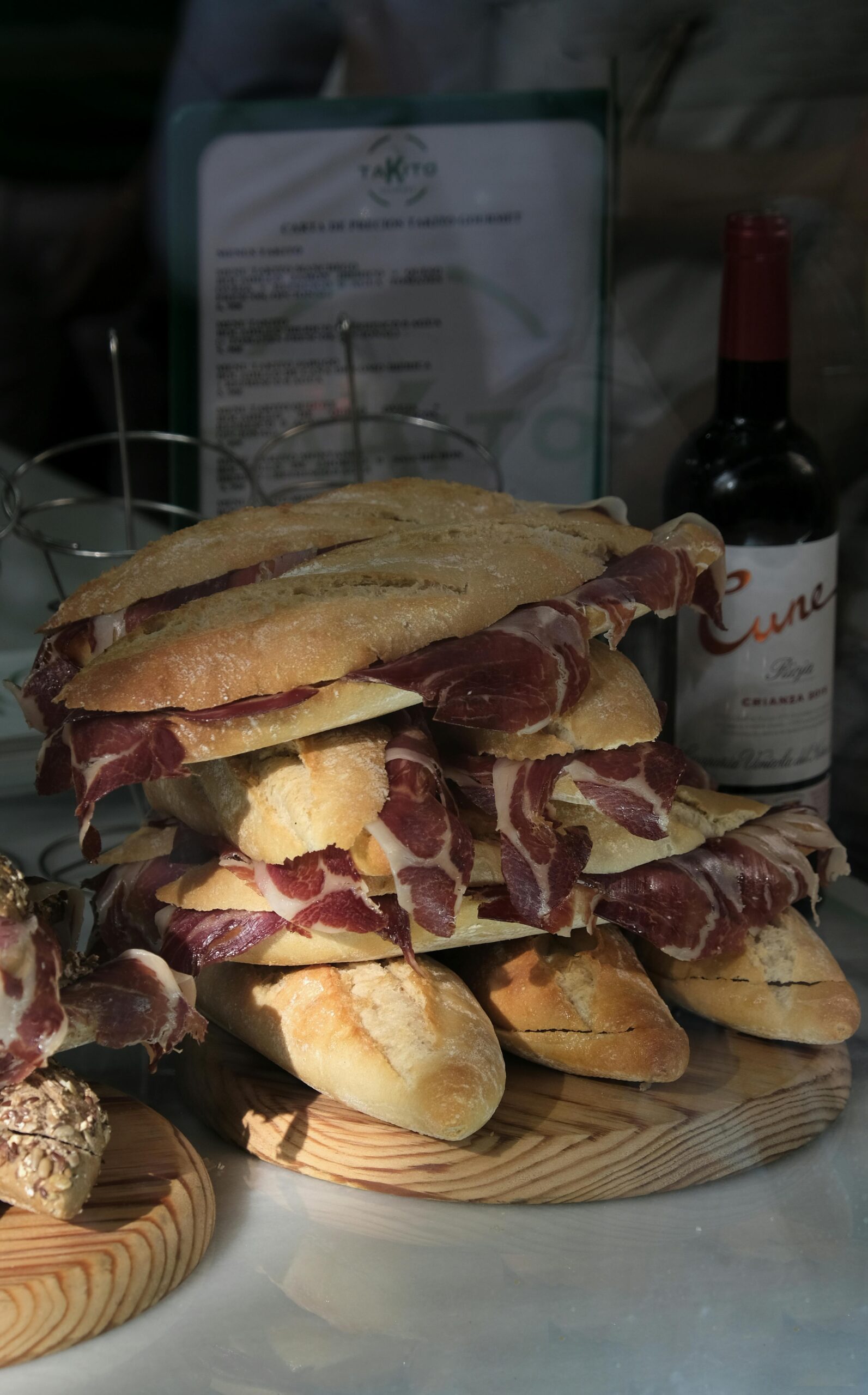
If there is one pork product that stands apart from everything else — one that we buy without the usual reservations — it is genuine Jamón Ibérico de bellota. Not because we've stopped thinking about welfare, but because the welfare and quality story here is almost unimpeachable.
Iberian pigs — the pata negra breed — are raised in the dehesa, the ancient oak woodland and pasture landscape of western Spain and Portugal. During the montanera season, typically October to February, the pigs roam freely across the dehesa foraging on acorns, roots, herbs and grasses. A single pig may consume up to 10 kilograms of acorns a day during this period. The fat that results — oleic acid-rich, deeply flavoured — is unlike anything produced by any other pig farming system in the world.
These are animals living as pigs are meant to live. Rooting. Foraging. Covering kilometres of ground each day. The montanera period lasts months. The pigs are slaughtered at 18 to 24 months — considerably older than any commercial breed. The hams are then cured for a minimum of 24 months, often 36 to 48 months for the finest examples.
The nitrate question is worth addressing directly. Conventional Jamón Ibérico — even high quality versions — typically contains added nitrites as part of the curing process. However, a growing number of producers are making genuinely nitrate-free Jamón Ibérico de bellota, relying entirely on salt, time and the controlled microclimate of traditional curing cellars to preserve the ham.
The long curing time — sometimes three years or more — means the salt has time to do the work that nitrites do in shorter-cured products. The result is a ham with a cleaner, more complex flavour and none of the preservative concerns associated with conventional cured meats. This is the version worth seeking out.
In Britain, genuine nitrate-free Jamón Ibérico de bellota is available from a small number of specialist importers and fine food retailers. It is expensive — a leg can cost several hundred pounds — but sold by the slice it is more accessible than that sounds. A few slices of properly cured bellota ham, eaten at room temperature with good bread, is one of the finest things you can eat. We have no hesitation about it whatsoever.
What to look for
Look for 100% Ibérico de bellota — this guarantees pure Iberian breed and acorn finishing. The black label (etiqueta negra) is the Spanish denomination for the highest grade. Ask specifically about nitrites — a reputable importer will know whether their producer uses them. Cinco Jotas, Joselito and Fermín are among the most respected names, though availability of genuinely nitrate-free versions varies. A good Spanish deli or specialist importer is a far better source than a supermarket.
Organic pork producers
worth knowing about
These are producers we have researched and believe to be genuinely worth seeking out. We do not take payment for listings — inclusion is based on certification, farming practice and transparency.
Questions we get asked
about organic pork
The nutritional differences between organic and conventional pork are real but modest. Organic pork from pigs raised on pasture tends to have a slightly better fatty acid profile — higher omega-3 content and a better omega-6 to omega-3 ratio — than pork from pigs fed on grain-heavy indoor diets. The differences are less dramatic than in beef or lamb, where the grass-fed distinction has a more pronounced effect on fat composition.
The stronger argument, as with other organic meats, is what organic pork doesn't contain. No routine antibiotic residues. No synthetic growth promoters. Feed produced without synthetic pesticides. And in the UK specifically, no ractopamine — the lean-promoting feed additive banned here and in the EU but widely used in countries like the US and Canada, from which pork imports are a live trade negotiation issue. Organic certification makes all of this irrelevant. That's worth something.
Routine antibiotic use is prohibited in certified organic pig farming. This matters particularly for pork because the conventional pig sector has historically been one of the heaviest users of antibiotics in British agriculture. High stocking densities, stress and poor air quality in intensive indoor systems create exactly the conditions in which disease spreads — and the industry's response has been to administer antibiotics preventatively rather than address the underlying conditions.
Organic pigs can be treated with antibiotics when genuinely ill — refusing treatment to a sick animal would be a welfare failure. But when an organic pig is treated, it must be withdrawn from the organic supply chain. The result is that organic pork carries a significantly lower risk of antibiotic residues and comes from a system that is not contributing to the routine antibiotic overuse that drives antimicrobial resistance.
This is the question we find most important for pork specifically — because pigs are not like cattle or sheep. They are highly intelligent animals, consistently ranked alongside dogs and chimpanzees in cognitive research. They form complex social relationships, communicate in sophisticated ways, and suffer measurably when deprived of stimulation and space. The conditions in which most British pigs are raised — indoors, on concrete, often unable to root or move freely — are difficult to reconcile with that intelligence.
Soil Association organic certification addresses the most serious welfare failures directly. Farrowing crates are prohibited. Routine tail docking is prohibited. Genuine outdoor access is required. Lower stocking densities are enforced. The gap between the best organic pig farming and conventional intensive production is as wide as anywhere in British agriculture. We wouldn't say organic pork is ethically uncomplicated — but it is considerably less complicated than the alternative.
The environmental picture for pork is mixed, as it is for most meat. Pigs are not ruminants — they cannot convert grass into protein the way cattle and sheep can. They require feed, and feed production has an environmental footprint. Conventional pig feed often includes significant quantities of imported soy, linked to deforestation in South America. Organic feed requirements reduce but do not eliminate this dependency.
On the positive side, organic pig farming at lower stocking densities produces less localised pollution — the slurry and ammonia problems associated with intensive indoor pig units are significantly reduced. Well-managed outdoor organic pig systems can also contribute to soil health, though they require careful rotation to prevent overgrazing and ground compaction.
Our honest view: pork has a meaningful environmental footprint however it's produced. Eating less of it and eating it better — from farms that manage their land well — is a more honest position than claiming organic pork is environmentally neutral. It isn't. But it is considerably better managed than intensive conventional production.
In our experience, significantly so — particularly from rare breed producers. Rare breed pigs — Gloucestershire Old Spot, Tamworth, Oxford Sandy and Black, Middle White — have been bred over centuries for flavour rather than yield. They carry more fat, grow more slowly and produce meat with a depth of flavour that commercial breeds simply don't match.
The difference is most obvious in the fat. Good organic pork from a rare breed pig has sweet, well-flavoured fat that you actually want to eat — quite different from the pale, tasteless fat on a supermarket chop. A slow-cooked shoulder or a properly cured chop from one of the producers listed on this page is a genuinely different eating experience. The premium is real. So is the difference.
Find certified organic pork
from British producers
Browse our directory of certified organic pork producers, butchers and delivery services across the UK — all independently verified and genuinely worth knowing about.